
Why Your Cat Is Destructive Indoors
Your furniture is shredded, your curtains are in tatters, and your cat acts like they own the place—which, to be fair, they’re pretty convinced they do. If you’re dealing with cat destructive behavior indoors, you’re definitely not alone. But before you chalk it up to your cat just being “bad,” it’s worth knowing that destructive behavior almost always signals something specific: your cat’s telling you their needs aren’t being met. So what’s actually going on?
Why Cats Become Destructive
Destructive behaviors are innate behaviors that are part of your cat’s natural sense of curiosity and a desire to play. It’s easy to feel personally attacked when your cat shreds your favorite sweater or scratches your couch to ribbons, but these behaviors are usually part of normal investigation and play—not revenge or malice.
Here’s what’s usually driving the chaos:
**Boredom and Lack of Stimulation**
The most likely cause of destructive behavior in cats is boredom or lack of enrichment in their indoor environment. One of the most frequent reasons cats become destructive is boredom. Indoor cats especially face a limited environment compared to their outdoor counterparts. When a cat’s brain isn’t engaged, they’re going to make their own entertainment—and that entertainment often involves your belongings.
**Stress and Anxiety**
Stress is another powerful trigger for destructive behavior in cats. Changes in routine, new pets or people in the household, loud noises, or even subtle shifts like moving furniture can unsettle a cat’s sense of security. Cats express stress differently than humans; one common outlet is through destructive acts like scratching or chewing on objects they shouldn’t.
**Natural Instincts Turned Inward**
Scratching is largely a marking behavior that deposits scent from special glands on the cat’s paws into his territory and removes the translucent covering, or sheath, from the claws. Cats normally are semi-nocturnal, hunting usually at dawn and dusk. They cannot change their normal sleep rhythm just because it keeps them awake. They are predatory hunters who use play to sharpen their hunting skills – it’s natural behavior for them to pounce on things or bat them around. Without proper outlets, these instincts get redirected toward your couch and walls.
How to Fix Destructive Behavior
The good news: these behaviors can most commonly be managed with an appropriate plan and patience. Here’s what actually works.
**Provide the Right Scratching Outlets**
Matching a cat’s preference for scratching orientation (i.e. horizontal versus vertical) and substrate (i.e. wood versus fabric) is vital in choosing scratching posts. If your cat loves scratching your couch, try placing scratching posts right nearby. Make them irresistible by rubbing a little catnip on them or using a spray that cats respond to. The key is having multiple posts around your home, positioned in the areas where your cat already likes to scratch.
**Increase Physical and Mental Play**
If you provide enough play and exercise time, the problem will diminish, and kittens do outgrow this tendency for the most part. You don’t need to spend hours playing with your cat, but consistent daily interaction matters.
- Active playtime with their owners is very beneficial – set a timer or play with your cat during an entire sitcom or movie.
- Rotate toys so your cat doesn’t get bored with the same ones. Hide a few away and bring fresh ones out regularly.
- Try feeder toys that require the cat to move them in order to get food, hiding kitten food bowls where they can be “discovered” or run madly through the house dragging a piece of ribbon – whatever works!
**Create Vertical Spaces**
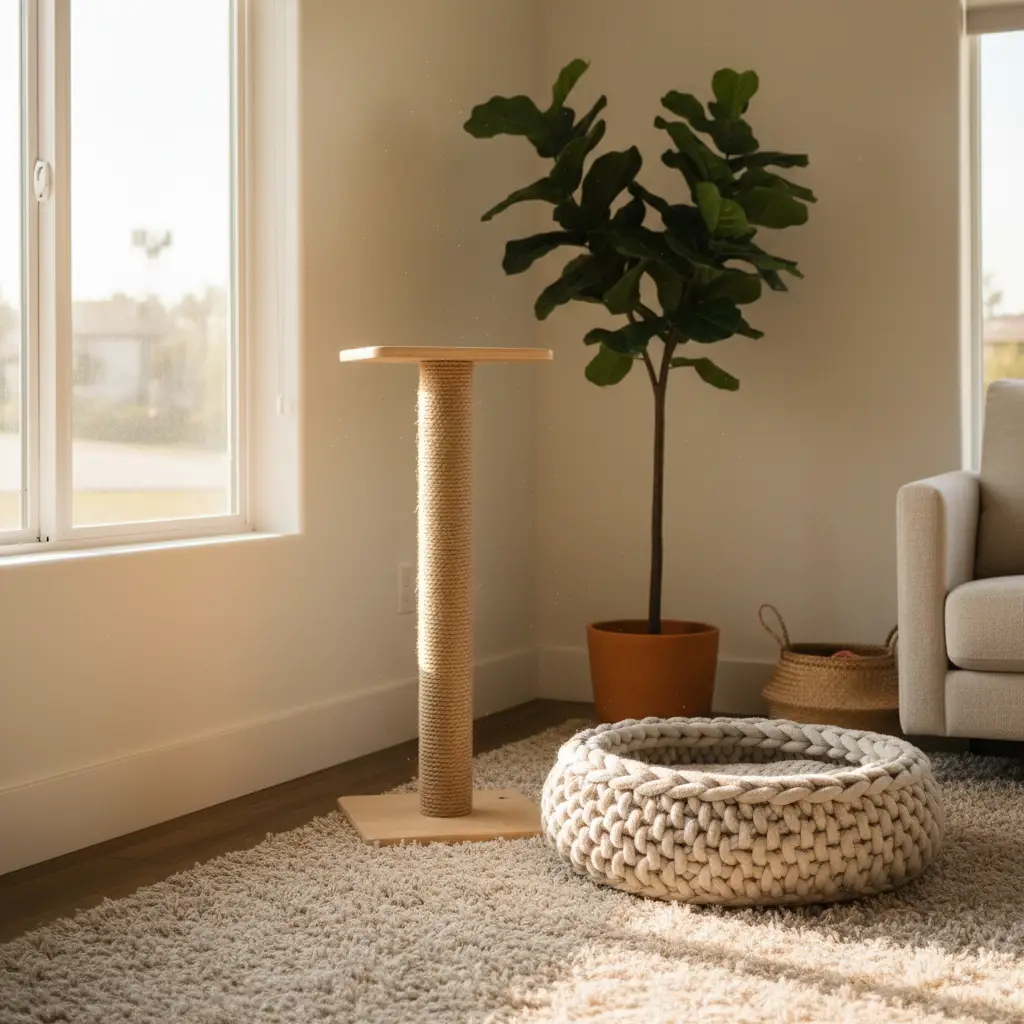
Incorporating cat furniture like cat trees, shelves, and climbing posts into your home can provide your cat with designated areas to explore and play. Cats love vertical space, and providing them with elevated surfaces can help satisfy their need to climb and scratch.
**Manage Their Environment**
If your cat is chewing on fabrics or climbing curtains, sometimes the simplest fix is reducing access. Covering items with blankets, sheets of plastic, or double-sided tape may also deter scratching. Close doors to rooms you can’t supervise closely. Block off areas where they’re causing the most damage while you redirect them to better outlets.
**Address Stress If It’s a Factor**
Providing safe hiding spots, pheromone diffusers like Feliway, and maintaining consistent routines can help reduce anxiety-driven destruction. If you’ve made recent changes to your home or routine, try keeping things as stable as possible while your cat adjusts.
**Skip Punishment**
There is nothing so difficult as ignoring these behaviors until they go away, and punishment rarely helps. Yelling at your cat, spraying them with water, or any other form of punishment typically backfires—it just stresses them out more.
Best Toys for Cats
The right toys can be a game-changer for indoor cats dealing with destructive urges. The best cat toys for indoor cats simulate natural hunting behaviors, provide aerobic exercise, and prevent the boredom-driven behavioral issues that affect an estimated 40% of strictly indoor felines.
When you’re looking to stock up on the best cat toys for indoor cats, consider mixing these types:
**Wand and Feather Toys**
These mimic birds in flight and trigger your cat’s prey drive instantly. Most cats go wild for the fluttering motion. The best ones have replaceable feathers and strong, flexible wands so they last longer. These are interactive, so they require your participation, but they’re some of the most engaging toys out there.
**Catnip and Silvervine Toys**
These plush toys are long enough for your cat to grab with their front paws and kick with their back legs—just like they would with real prey. Stuffed with catnip or silvervine, they’re irresistible to most cats. They’re great for solo play, so your cat can entertain themselves when you’re busy.
**Track Toys and Ball Towers**
Track toys are generally great options for indoor cats since they make it possible for kitties to entertain themselves. It’s not a robotic or electronic toy, and cats are responsible for creating their own action! The Catstages Tower of Tracks is one of the most reliable long-duration toys for indoor cats. Featuring multiple stacked tracks with enclosed rolling balls, it allows cats to bat, paw, and chase without the balls ever leaving the structure. This containment keeps play focused and frustration-free.
**Puzzle Feeders**
Puzzle feeders increase the difficulty level as your cat learns. It is a great way to stimulate your cat’s meal times mentally and physically. And it can also help with weight management by making your buddy work for their food. These turn feeding time into enrichment, which is huge for bored indoor cats.
**Laser Toys**
Automatic laser toys have evolved significantly, and modern models stand out for their motion detection, randomized patterns, and adjustable timers. These toys project unpredictable laser paths across floors and walls, encouraging cats to sprint, pivot, and leap with minimal setup. When used correctly—ideally followed by a physical toy or treat to “complete the hunt”—laser toys provide excellent cardiovascular exercise and help release pent-up energy.
The beauty of having a variety is that different cats respond to different toys. Some will obsess over feather wands, others prefer the independence of a track toy. Try a few different types and see what your cat gravitates toward. There should be enough different ones that you can hide some away and rotate out new ones on a regular basis so the cat doesn’t get bored with the same two toys month after month.
P.S. This post contains affiliate links at no extra cost to you. The products featured here consistently showed up as top options during our research, and we aim to provide the most accurate and helpful information possible.
FAQ
**Why does my cat scratch the furniture if I provide scratching posts?**
Your cat might have specific preferences for scratching orientation or texture. Matching a cat’s preference for scratching orientation (i.e. horizontal versus vertical) and substrate (i.e. wood versus fabric) is vital in choosing scratching posts. Also, because scratching has a scent-marking component, cats are more likely to re-scratch areas that already have their scent. Try placing posts directly near problem areas and using scent neutralizers on furniture they’ve already damaged.
**How much playtime does my indoor cat actually need?**
You don’t need to spend hours each day playing. Just 10 to 15 minutes of focused interaction a couple of times a day can make a big difference. The key is consistency—daily play is better than sporadic long sessions.
**Can destructive behavior be a sign of a health problem?**
Sometimes, yes. This may involve observing your cat’s behavior patterns, consulting with a veterinarian to rule out medical issues, and seeking advice from animal behaviorists or trainers. If your cat’s destructive behavior is new or suddenly worse, a vet checkup is worth doing to rule out underlying medical issues.
**Is punishment ever okay for stopping destructive behavior?**
No. Punishment can increase stress. Instead, focus on redirecting your cat to appropriate outlets and managing their environment. Positive reinforcement—rewarding them when they use scratching posts or toys correctly—is far more effective.
**What if my cat just seems to destroy everything no matter what I try?**
It might be worth consulting with a veterinary behaviorist to explore whether stress, anxiety, or other underlying factors are at play. Some cats benefit from changes to their environment (more vertical space, hiding spots, etc.), while others respond well to enrichment-focused strategies like puzzle feeders and interactive play. If you’ve ruled out medical issues and your cat is still struggling, professional guidance can help identify what your specific cat needs.